

Discovery of P-Wave Magnetism in EuSi
Researchers have identified evidence for p-wave magnetism in the electronic band structure of metallic Europium Silicon (EuSi). The findings, published in Nature, were made using angle-resolved photoemission spectroscopy (ARPES) and spin-ARPES, alongside neutron scattering and symmetry analysis.
Key Findings
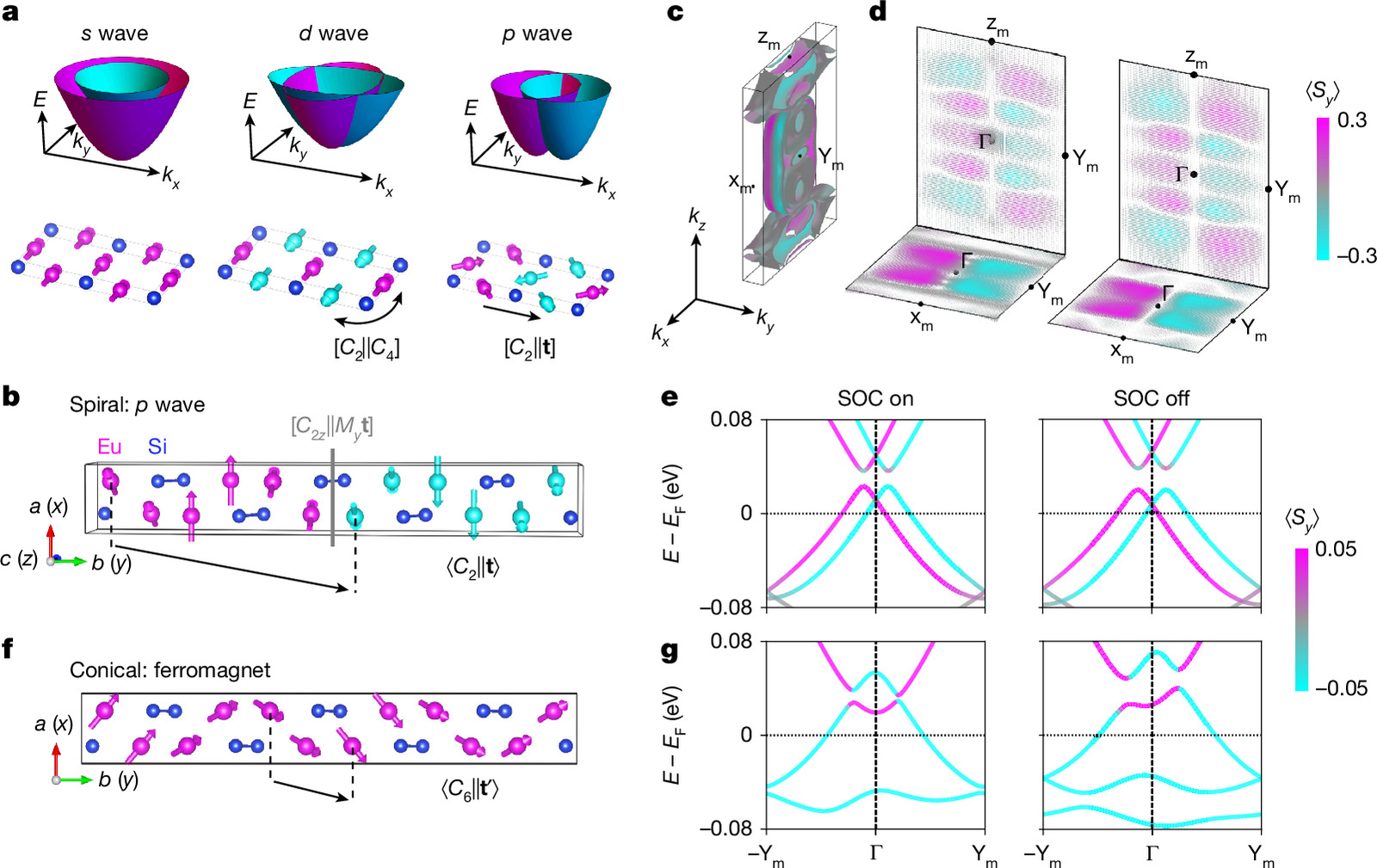
Neutron diffraction revealed a chiral spiral phase within EuSi between 33.4 K and 62 K. This phase fulfills criteria characteristic of p-wave magnetism, maintaining combined time-reversal and lattice translation symmetry while breaking inversion symmetry. Spin-integrated ARPES demonstrated a significant reconstruction of the electronic structure, with energy separations exceeding 100 meV, linked to strong 4f–5d exchange coupling.
Spin Polarization
Spin-ARPES analysis confirmed the presence of odd-parity spin polarization, with a sign-changing modulation across magnetic Brillouin zones. Notably, this polarization was suppressed near nodal regions, aligning with predicted p-wave spin textures and unfolded spin-polarization calculations.
Structural Details
Magnetic force microscopy (MFM) and micro-ARPES techniques identified approximately 10-µm chiral magnetic domains. The magnetic structure is described by the spin space group ({{}^{{2}_{y}}C}^{1}{m}^{{m}_{x}}{c}^{1}{m}^{{m}_{y}}1), which breaks inversion symmetry and allows for odd-parity spin polarization.
Experimental Techniques
Researchers combined several experimental techniques to reach this conclusion: angle-resolved photoemission spectroscopy (ARPES), spin-ARPES, neutron diffraction, and magnetic force microscopy (MFM) and micro-ARPES.
Next Steps
The research identifies EuSi as a suitable material for further investigation into p-wave magnetism and related spin-symmetry-based functionalities, including spintronics, topological matter, and superconductivity. Future research will likely focus on exploring the potential of EuSi in these applications.
Source: Nature. Featured image credit: Nature.


Leave a Reply