

New Research on Altermagnetism
Researchers have developed a photonic crystal that replicates altermagnetism, a state where a material displays magnetization without an external magnetic field. This research, published in Nature, offers a new method for studying this phenomenon.
Understanding Altermagnetism
Altermagnetism is a peculiar property of certain materials. These materials exhibit a magnetization, or a tendency to align their magnetic moments, even when not subjected to an external magnetic field. Previous research, as detailed in Phys. Rev. X and Nature, has explored this behavior in various materials.
The Photonic Crystal Approach
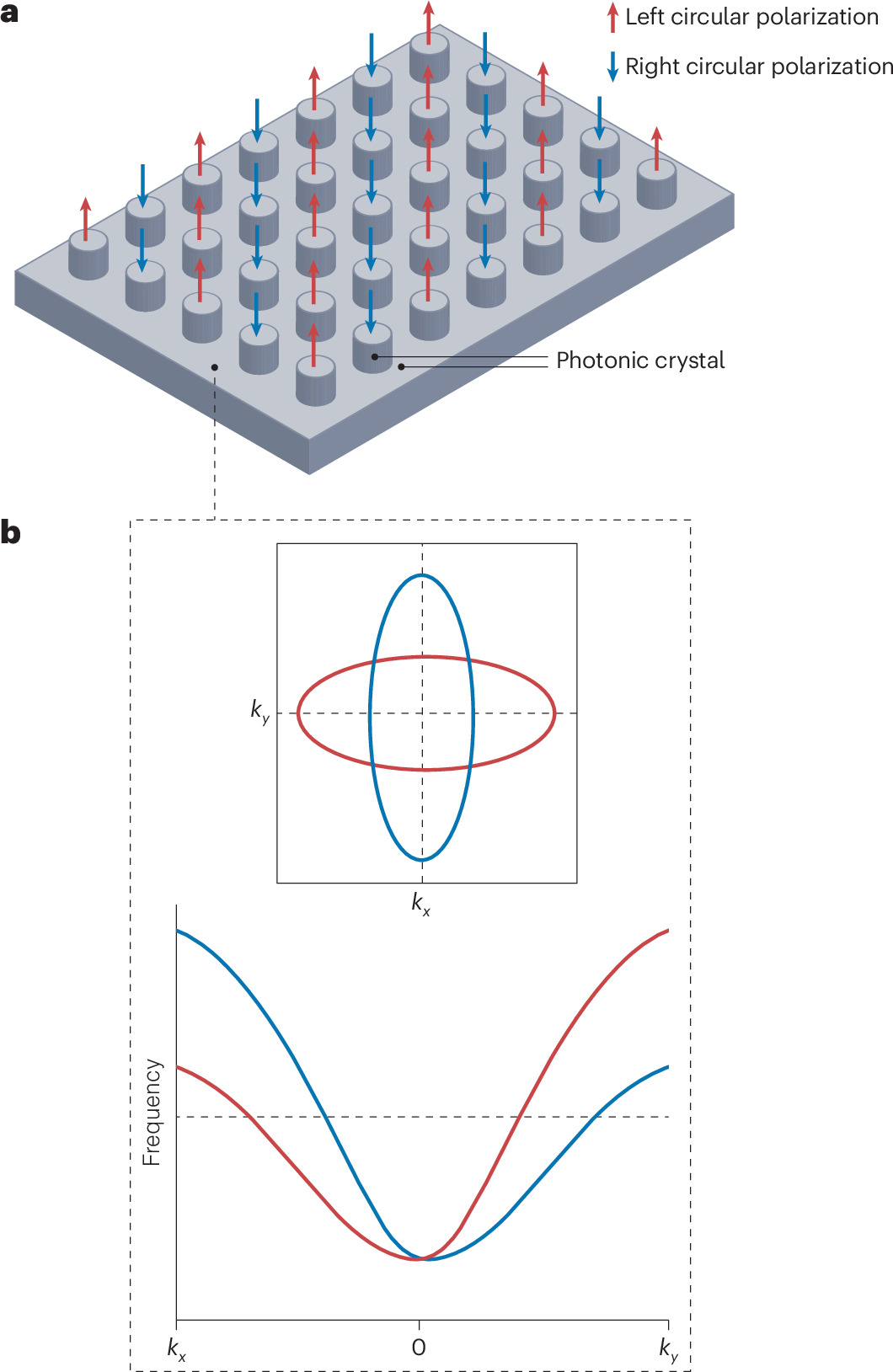
The latest study, published in Nature Physics in 2026, utilizes a photonic crystal to reproduce the symmetry-driven characteristics of altermagnetism. The researchers employed circular polarization as an analogue for the spin of electrons, a concept previously explored by Joannopoulos, Villeneuve, and Fan (1997) and Wang et al. (2009).
Key Details of the Experiment
- The research utilized a photonic crystal, a structure with a periodic arrangement of dielectric materials.
- Circular polarization was used as a substitute for the spin of electrons.
- The work builds upon prior research in the field, including studies by Šmejkal, Sinova, and Jungwirth (2022) and Chen et al. (2026).
Future Implications
This new approach could provide a valuable tool for investigating altermagnetism and potentially lead to the development of novel optical technologies. The research, led by Yang, demonstrates a significant step forward in understanding and manipulating this unusual magnetic behavior.
Further Information
The original research article can be found at: https://doi.org/10.1038/s41567-026-03532-9
Source: Nature. Featured image credit: Nature.


Leave a Reply