

Experimental Simulation of Quantum Fields
Researchers have successfully simulated a massive relativistic quantum field in two spatial dimensions and time using a two-component atomic Bose-Einstein condensate. This work, published in Nature, provides a platform to study complex quantum phenomena and their relevance to the early universe.
The Sine-Gordon Model
The experiment focused on realizing the paradigmatic sine-Gordon model, a key theoretical model in quantum field theory. Specifically, the researchers encoded this model into the relative phase of two components within the Bose-Einstein condensate.
Two-Component Condensate
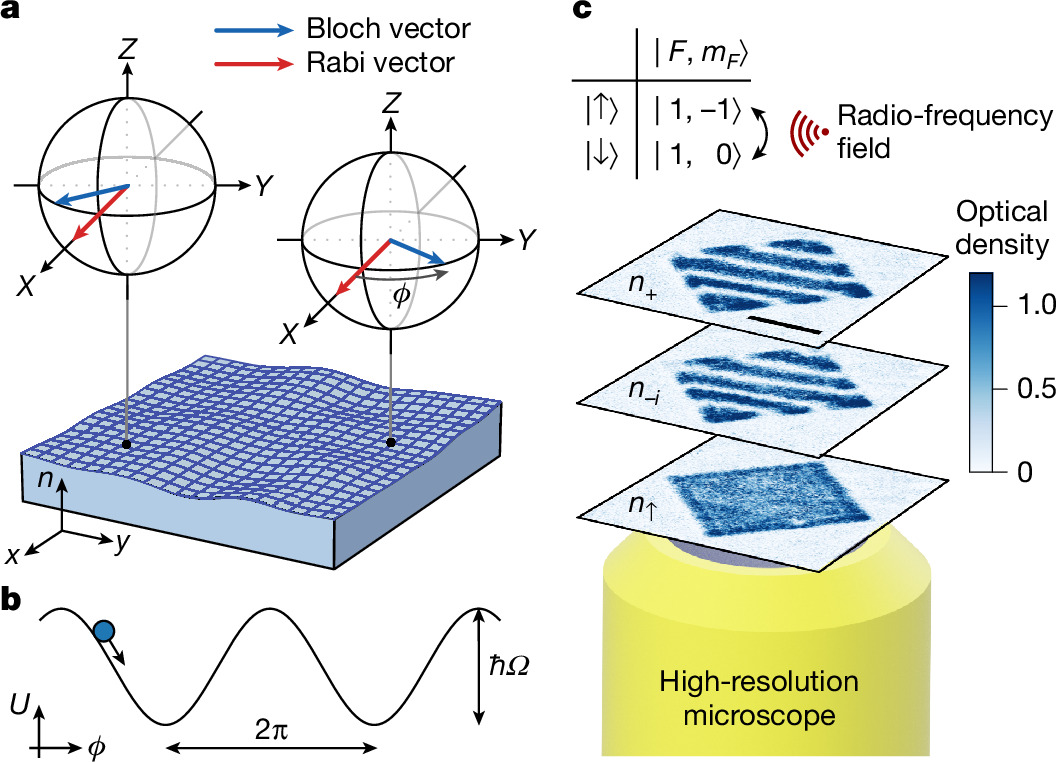
The simulation utilized a coherently coupled mixture of two miscible hyperfine states of 39K atoms. These two states, denoted as (|uparrow rangle) and (|downarrow rangle), were manipulated using radio-frequency fields and spin-dependent interactions. The relative phase between the two components was crucial for simulating the model’s dynamics.
Key Parameters
The experiment operated with parameters including a Rabi frequency of up to 2π × 20 kHz, a magnetic field stability of approximately 150 μG, and a contact interaction strength characterized by parameters ({g}_{sigma {sigma }^{{prime} }}propto {a}_{sigma {sigma }^{{prime} }}). The temperature of the condensate was estimated to be less than 10 nK.
Measuring Spin Dynamics
State-selective absorption imaging was used to directly image the densities of the two spin components. π/2 spin rotations were applied before imaging to measure additional properties, such as n↑,↓(x, y) and n+,−(x, y). Furthermore, projections of the global Bloch vector were measured after releasing the atoms and spatially separating the components using a Stern–Gerlach gradient.
Observing Non-Perturbative Phenomena
The researchers observed explicitly non-perturbative phenomena, including the existence of topological domain walls. These domain walls, characterized by rapid winding of the relative phase by 2π, are a key feature of the sine-Gordon model and are not observed in one-dimensional simulations.
Potential Applications
This analogue simulation opens possibilities for studying cosmologically relevant phenomena such as preheating, dynamics of topological defects, and relativistic false-vacuum decay. The ability to explore these phenomena in a controlled laboratory setting provides valuable insights into fundamental physics.
Source: Nature. Featured image credit: Nature.


Leave a Reply