

Introduction
This article reports on research published in Nature concerning a theoretical framework for quasi-periodic temporal photonic crystals (PCs) based on the Kolakoski sequence. The study, conducted by researchers, investigates the properties of these structures and their potential applications in ultrafast photonic devices.
Key Findings
The research demonstrates that aperiodic temporal PCs, utilizing the Kolakoski sequence, can exhibit momentum gaps and richer wave dynamics compared to conventional periodic PCs. Increasing the permittivity contrast and varying layer durations within the structures leads to enhanced momentum gaps and shifts in the momentum spectrum.
Kolakoski Sequence and Temporal PCs
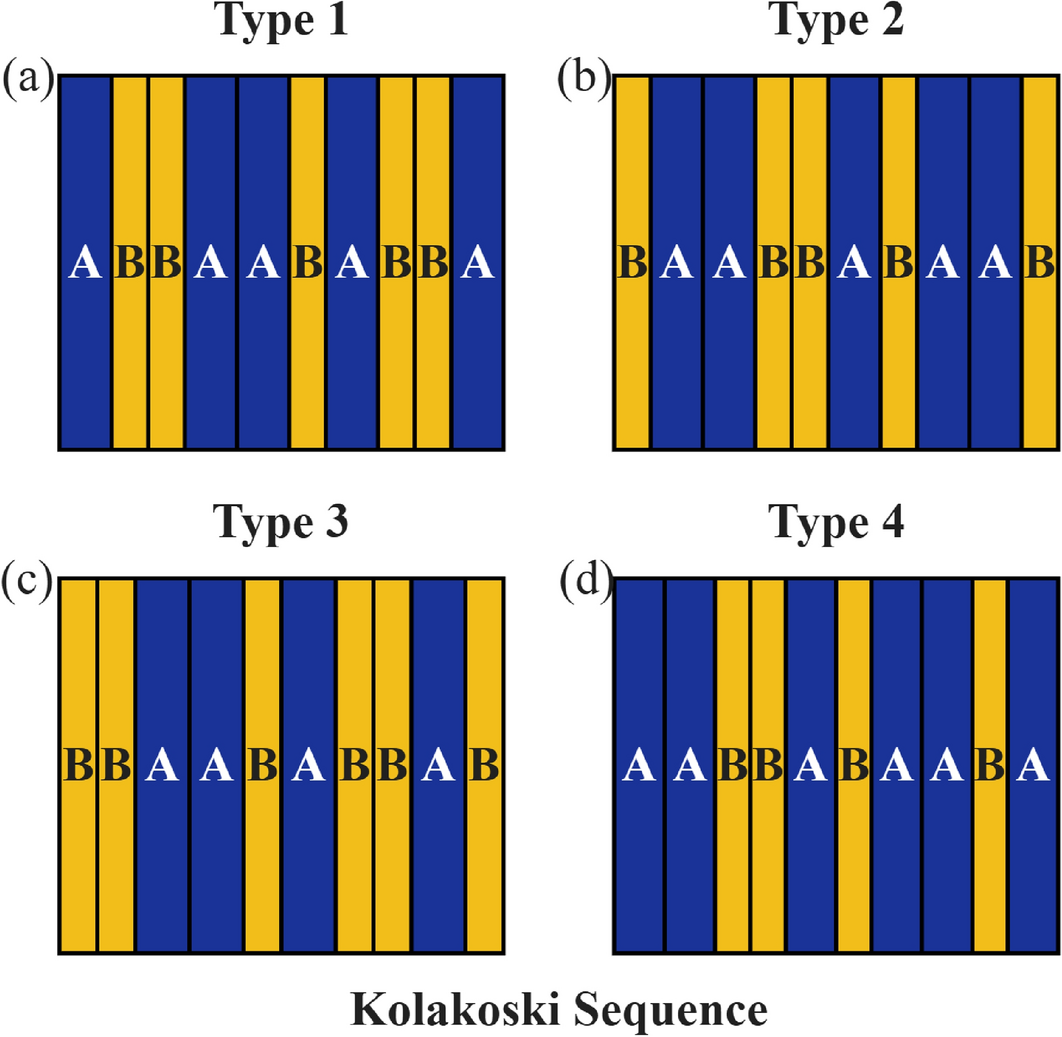
The Kolakoski sequence is a self-generating, deterministic aperiodic sequence used to create the temporal PCs. Four distinct types of these PCs – Type-I, Type-II, Type-III, and Type-IV – were analyzed. Each type is defined by the arrangement of alternating temporal layers (A and B) based on the Kolakoski sequence.
Structural Details
Each structure consists of two temporal media, assigned to temporal layers A and B. The sequence is generated through iterative substitution rules, creating a deterministic aperiodic arrangement. For example, Type-I (( textrm{K}(1,2))) is defined as (textrm{A,B,B,A,A,B,A,B,B,A,B,B,…}). The researchers used the transfer matrix method (TMM) to analyze the propagation of light and the optical properties of these PCs.
Material Properties
The relative permittivities of the two temporal media were set to (varepsilon _{textrm{A}}=3) and (varepsilon _{textrm{B}}=1), while the relative permeabilities were fixed at (mu _{textrm{A}}=mu _{textrm{B}}=1). The refractive indices were given by (n_{textrm{A}}=sqrt{var}). The study examined both lossless and lossy regimes, observing that material loss slightly enhances amplification without significantly altering the position of the momentum gaps.
Future Research
According to the research, Kolakoski-based temporal PCs hold potential for ultrafast, dynamically tunable photonic devices. Further research will likely focus on exploring the localization properties of these systems and their applications in areas such as filters, switches, and robust ultrafast photonic devices.
Source: Nature. Featured image credit: Nature.


Leave a Reply