

New Method Reduces Computational Burden for Excited State Calculations
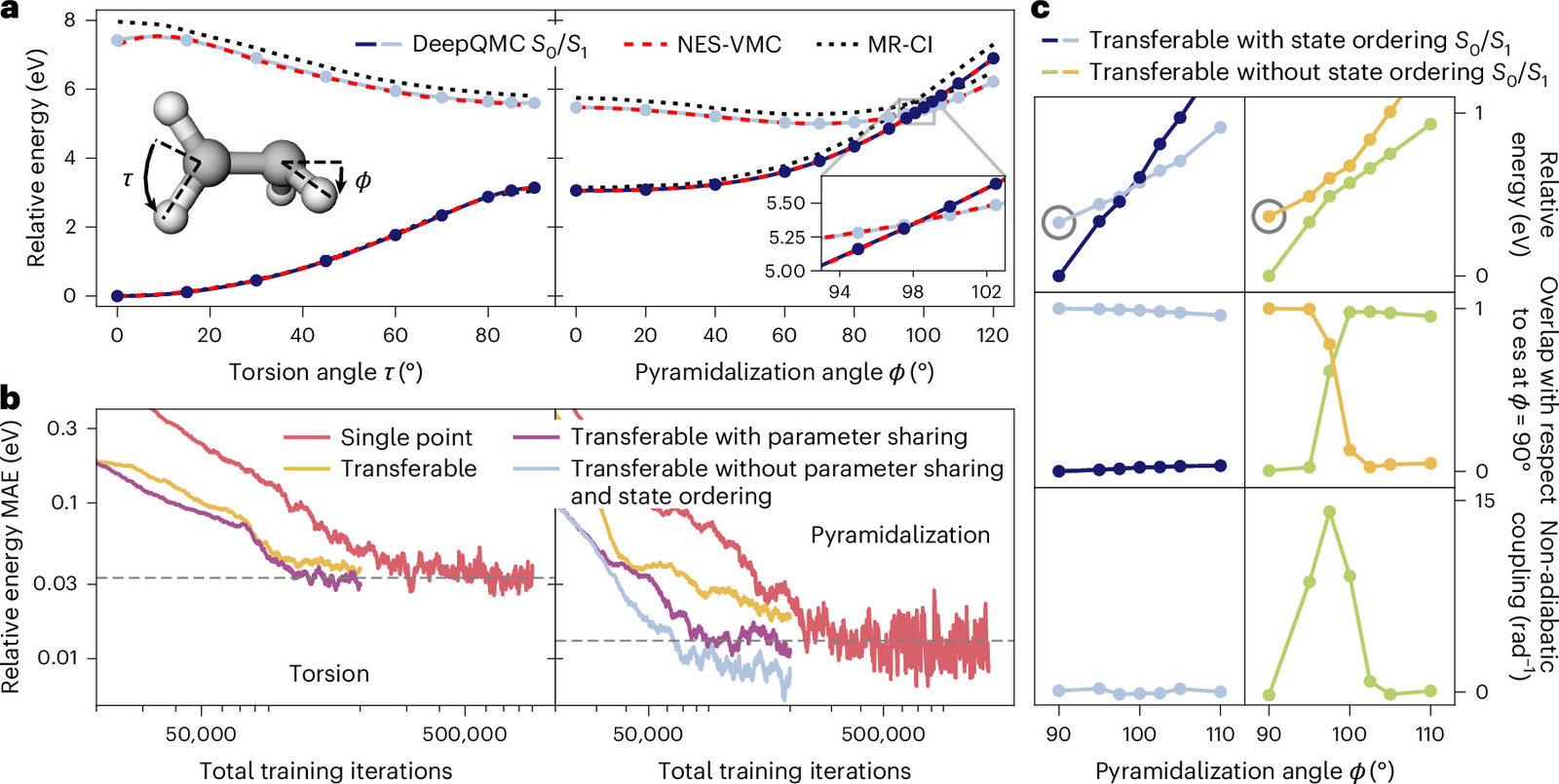
Researchers have introduced a novel approach utilizing deep learning to improve the accuracy and efficiency of calculating excited states in molecules. The research, published in Nature, focuses on reducing the computational demands associated with determining ground and excited potential energy surfaces (PESs).
Key Findings and Method Details
Accurate quantum chemical calculations of excited states are traditionally computationally intensive. Existing methods often rely on less accurate approaches to achieve the desired level of detail, leading to reduced accuracy. The new method employs a geometrically transferable optimization of neural network wavefunctions. This technique incorporates weight sharing and a dynamic ordering of electronic states to enhance efficiency.
Significant Cost Reduction
The research demonstrates a potential cost reduction of up to two orders of magnitude compared to traditional single-point calculations. This improvement allows for the prediction of ground and excited-state PESs and their intersections with greater accuracy.
Validation and Examples
The approach was validated using four challenging examples: ethylene, the carbon dimer, the methylenimmonium cation, and a rubredoxin active site model containing 96 electrons. These tests illustrate the method’s potential for practical applications in studying electronic excitations.
Availability of Pre-print
A preprint version of the article is available on arXiv.
Source: Nature. Featured image credit: Nature.


Leave a Reply