

New Phase Diagram of UTe2 Reveals Complex Superconducting Behavior
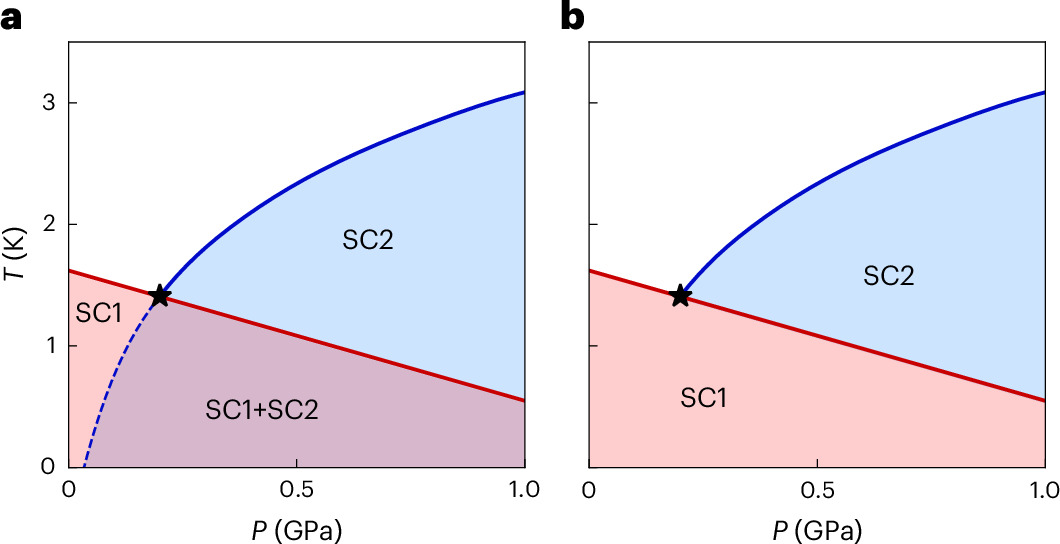
Researchers at Cornell University, the University of Maryland, and collaborating institutions have published findings detailing a new thermodynamic phase diagram of the material UTe2. The study, published in Nature, provides definitive evidence for a tetracritical point and establishes a framework for understanding multicomponent superconductivity in this complex compound.
Key Findings and Observations
The research team observed an additional phase boundary characterized by an upward jump in the sound velocity, providing direct thermodynamic evidence of a phase transition where superconducting order is lost upon cooling. This discovery challenges previous understandings of superconductivity in UTe2, which exhibits multiple superconducting states.
Thermodynamic Evidence and the Tetracritical Point
The data collected, including measurements of pressure and sample length, were fitted to polynomial equations. These fits revealed a tetracritical point – a point beyond which the ambient and pressure-induced superconducting order parameters form a multicomponent state. This suggests strong competition between the two superconducting order parameters drives the loss of order when cooling, leading to phase locking that suppresses superconducting fluctuations.
Experimental Methodology
The research utilized ultrasonic measurements to determine the pressure of the sample at low temperature (4 K) and at room temperature. These measurements were combined with data on the change in length of the pressure cell, providing a comprehensive picture of the material’s behavior under pressure. The data is freely available via GitHub: https://github.com/CHiLL-Ramshaw/manuscripts-supporting_data/tree/main/2026_UTe2_Tetracriticality
Supporting Research
The research was supported by grants from the Department of Energy and the Simons Foundation. Previous studies have explored single-component superconductivity in UTe2, multiple superconducting phases, and pressure-induced antiferromagnetic quantum critical points. Related research includes work on Sr2RuO4, UTe3, and the theoretical foundations of unconventional superconductivity, as referenced in the publication.
Next Steps and Further Research
Researchers are continuing to investigate the implications of this new phase diagram and the mechanisms driving the observed phase locking. Future work will focus on exploring the material’s behavior under different conditions and further characterizing the nature of the multicomponent superconducting state. The Helmholtz Institute Berlin and the University of Maryland are continuing to investigate field-induced tuning of the pairing state in a superconductor.
Source: Nature. Featured image credit: Nature.


Leave a Reply