

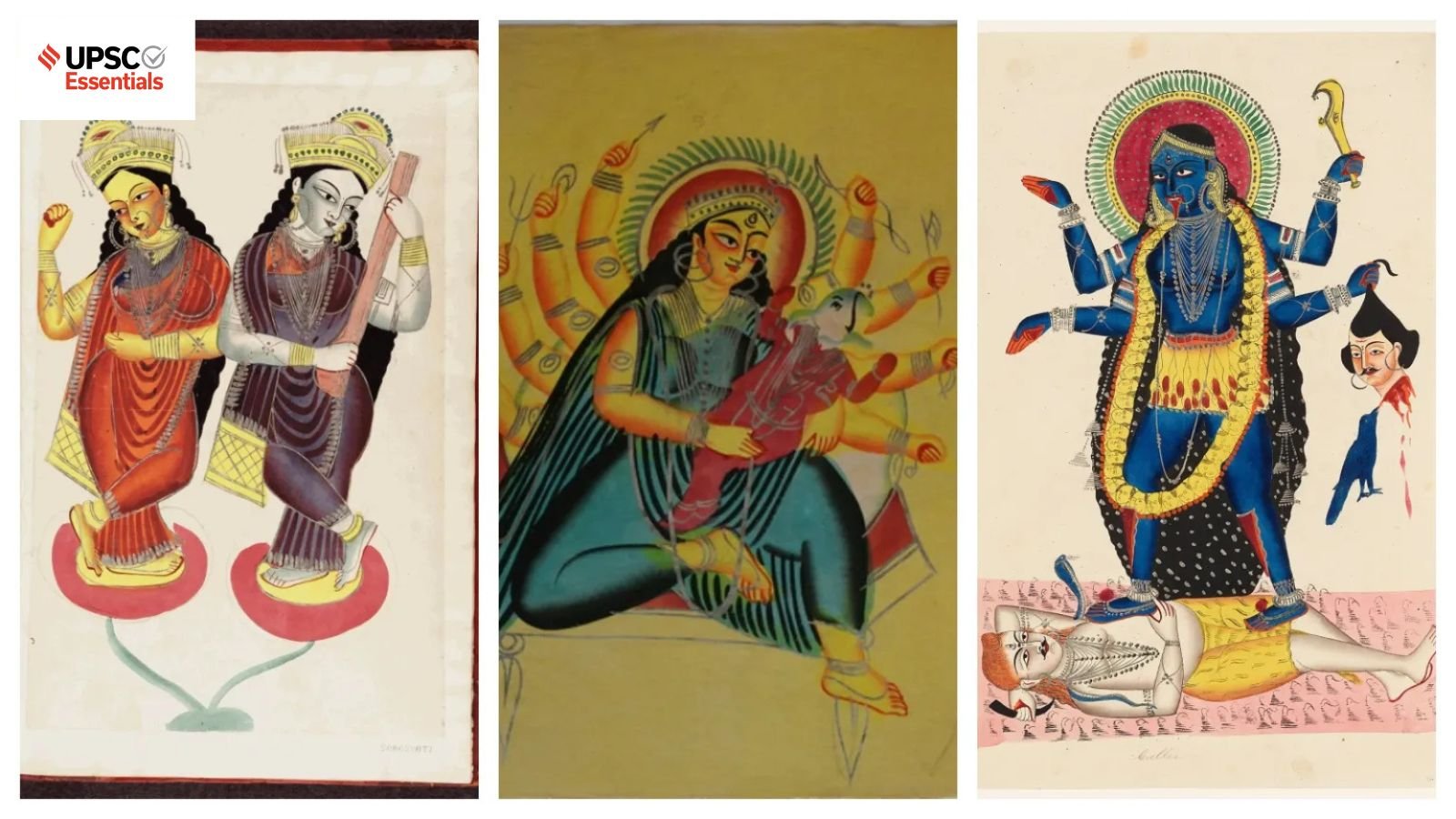
Kalighat Paintings: A Reflection of Contemporary Society
This UPSC Essentials question focuses on Kalighat paintings and their significance as a reflection of 19th-century Bengali society. The question, sourced from The Indian Express, explores how these folk art traditions captured social realities, political developments, and evolving lifestyles.
Key Characteristics and Themes of Kalighat Paintings
Kalighat paintings, originating at the Kalighat Kali temple in Calcutta, initially served as inexpensive pilgrim mementos. They depicted Hindu deities and mythological stories while also reflecting colonial influence, urban culture, and social issues. The paintings are characterized by bold outlines, vibrant colors, and simplified figures.
Artists utilized satire and caricature to comment on contemporary behaviors. Women, portrayed in roles such as goddesses, wives, and courtesans, highlighted gender dynamics and social status within colonial Bengal. Examples like “Barber Cleaning a Woman’s Ear” provided commentary on sexuality and domestic relationships.
Evolution and Adaptation
The shift from large narrative scrolls to smaller, portable paintings reflected changing consumer preferences and urban lifestyles. Artists adapted their themes to appeal to a diverse audience, including pilgrims, city dwellers, merchants, and European collectors.
Preservation and Significance
According to the source material, preserving these art forms is crucial for understanding India’s social past and protecting its cultural legacy. They offer valuable insights into colonial modernity, social hierarchies, and popular culture.
The French Revolution’s Influence on India
The question also addresses the impact of the French Revolution on Indian political developments. The revolution’s ideals of liberty, equality, and fraternity resonated beyond Europe.
Experiments in Democratic Governance
In French colonies like Pondicherry, representative assemblies, militias, and municipalities were established, offering Indians a degree of political participation. Similar experiments occurred in Yanam, Mahé, and Karaikal, challenging colonial administrative power.
Impact on Social Reform
Revolutionary principles inspired social reforms, including the abolition of slavery, the establishment of schools, and measures to combat agrarian exploitation. Peasants, laborers, and Indian troops sought rights against oppressive powers.
Alliance with Regional Powers
Tipu Sultan of Mysore forged diplomatic ties with Revolutionary France, establishing a republic at Srirangapatna and implementing agrarian reforms. The Marathas, a rising power in northern India, also allied with France to challenge British dominance.
British Response
The British viewed these revolutionary ideas and French connections as a threat to their colonial interests, leading to the conquest of Pondicherry and the suppression of Tipu Sultan.
Further Exploration
For more information, refer to the UPSC Essentials magazine for October 2026, available at https://indianexpress.com/article/opinion/ideas/upsc-essentials-kalighat-paintings-french-revolution-week-179/. Additional resources include articles on “From goddesses to gossip: The many stories of Kalighat paintings,” “A new series of Kalighat pat paintings by Uttam Chitrakar celebrates gay love and transpersons,” and “‘The Babu and The Bazaar’ at DAG celebrates art of 19th-Century Bengal.”
Source: The Indian Express. Featured image credit: The Indian Express.


Leave a Reply