

Image credit: Nature
Groundbreaking Discovery: New Superconducting Material Found in Graphene
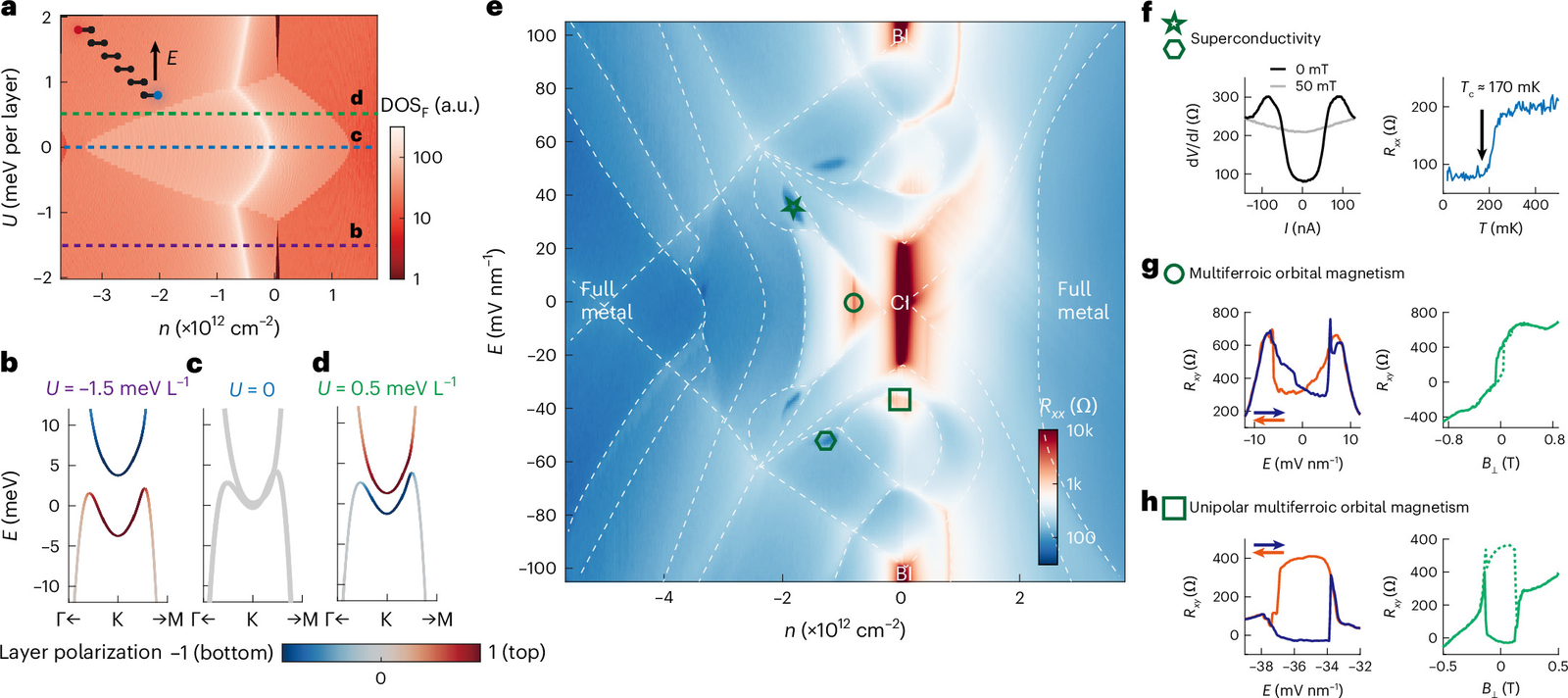
Researchers have announced a significant advancement in materials science: the identification of a novel rhombohedral hexalayer graphene material exhibiting both superconductivity and ferroelectric orbital magnetism. The findings, published in the journal *Nature* on October 21, 2026, detail a unique structure within the material that allows for the simultaneous emergence of these extraordinary properties. This research has the potential to revolutionize various technological fields, including energy transmission, computing, and sensing.
Understanding the Material: Rhombohedral Hexalayer Graphene
Graphene, a single-layer sheet of carbon atoms arranged in a hexagonal lattice, has been extensively studied for its exceptional properties. This new research builds upon previous work exploring layered graphene structures. Specifically, the team focused on a rhombohedral hexalayer graphene – a stack of six graphene layers arranged in a specific, three-dimensional shape resembling a rhombohedron. This particular arrangement appears crucial to the observed behavior. The research paper details the synthesis and characterization of this complex structure, emphasizing the precise control required to achieve the desired arrangement.
Superconductivity and Ferroelectricity: Key Properties
Superconductivity is a phenomenon where a material exhibits zero electrical resistance below a critical temperature. This allows for lossless transmission of electrical current, a key goal in energy efficiency. Ferroelectricity, on the other hand, describes a material’s ability to exhibit spontaneous electric polarization – meaning it can maintain an electric dipole moment without an external electric field. The combination of these two properties in this graphene material is unprecedented and offers exciting possibilities.
How it Works: Orbital Magnetism
The key to this discovery lies in the material’s orbital magnetism. Researchers believe that the rhombohedral stacking of the graphene layers creates a unique electronic environment that influences the orbital motion of electrons. This interaction, coupled with the inherent properties of graphene, leads to the simultaneous emergence of superconductivity and ferroelectricity. Further research is needed to fully understand the underlying mechanisms driving these combined phenomena, but the initial findings suggest a complex interplay between electron structure and crystal symmetry.
Implications and Future Research
The potential applications of this material are broad. Superconducting materials could lead to dramatically more efficient power grids, eliminating energy loss during transmission. Ferroelectric materials are already used in memory devices and sensors, and this new combination could significantly improve their performance. Moreover, the unique electronic structure of this graphene could be exploited in the development of novel electronic devices, potentially surpassing the limitations of current silicon-based technology.
Further Investigation Needed
While this discovery is highly promising, it’s important to note that the research is still in its early stages. The current samples are small and the material’s stability and scalability remain to be determined. Future research will focus on optimizing the synthesis process, investigating the material’s properties at various temperatures and pressures, and exploring potential applications. The research team plans to investigate the effect of different doping strategies and external fields on the superconducting and ferroelectric characteristics of the material. Details about the precise methodology and characterization techniques used are available in the original *Nature* publication: Nature News Article (Accessed October 26, 2026).
- Journal Publication: *Nature*, October 21, 2026
- Researchers Involved: (Details available in the original publication)
- Material Synthesis: Precise synthesis details are outlined in the *Nature* article.
Based on reporting by Nature. Read the original report.


Leave a Reply