

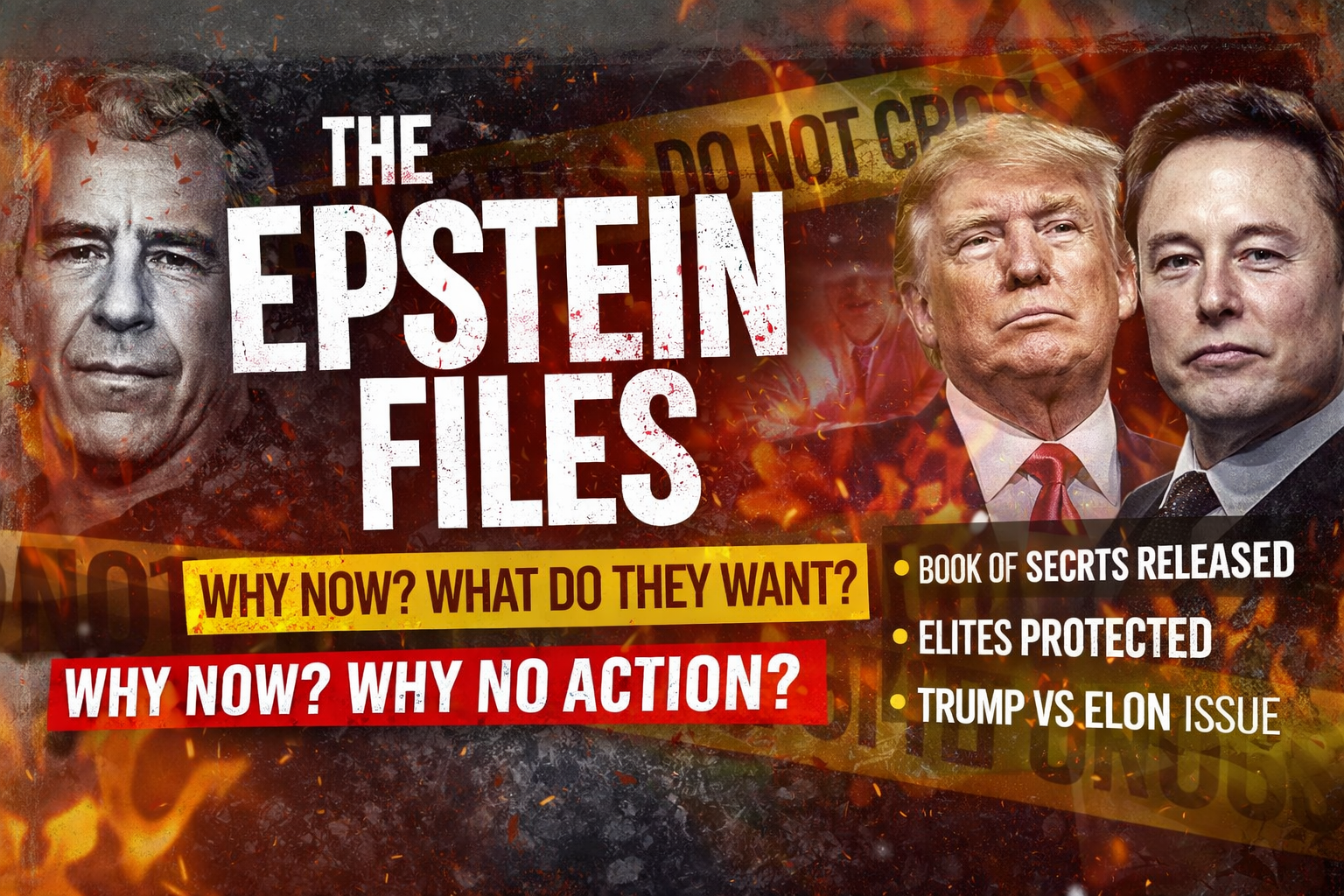
In recent months, renewed attention around the so-called “Epstein files” has once again pushed one of the darkest chapters of elite misconduct into global headlines. Documents, testimonies, and unsealed records connected to Jeffrey Epstein are being circulated and discussed widely—especially on social media and alternative news platforms.
But this raises a serious question: Why now?
Why is this information resurfacing at a time when most of the people involved are either protected by power, dead, or legally untouchable?
And why is this happening alongside high-profile tensions involving Donald Trump and Elon Musk?
This article explores what’s really happening beneath the surface—and how it could shape politics, media, and public trust in the coming years.
The Epstein Files: Old Evidence, New Attention
Most of the documents linked to Epstein are not “new” in the true sense. Many were part of:
- Court filings
- Victim testimonies
- Sealed civil cases
- Investigative journalism reports
- Settlement records
Over the years, these files remained inaccessible to the public due to legal protections, confidentiality clauses, and political sensitivity.
When some of them are suddenly unsealed or amplified online, it creates the illusion of a “big revelation.” In reality, it is often controlled transparency—information released only when it is no longer dangerous to those in power.
This is not justice.
It is damage management.
Why Are They Being Released Now?
1. Political Timing
We are entering an era of high political tension—elections, ideological polarization, and growing distrust in institutions. In such periods, controversial material is often released to:
- Shift media focus
- Weaken opponents
- Control public narratives
- Distract from current crises
The Epstein files become a tool—not for accountability, but for influence.
2. The Trump – Musk Power Dynamic
The growing ideological and public disagreements between Trump and Musk represent something bigger: a clash between political power and technological-media power.
- Trump represents traditional populist political authority.
- Musk controls major platforms, infrastructure, and digital narratives.
When elite conflicts intensify, sensitive information often resurfaces not to expose truth, but to create leverage.
The Epstein narrative fits perfectly into this environment.
3. No Real Legal Threat Remains
Let’s be honest:
Most individuals linked indirectly to Epstein:
- Have no direct criminal evidence against them
- Are protected by time limits
- Have top legal teams
- Are politically insulated
So releasing documents now is “safe.”
No system will collapse.
No major leader will go to prison.
No elite network will truly be dismantled.
This makes disclosure politically cheap.
Why No Real Action Is Being Taken
1. Structural Protection of Elites
Global legal systems are not neutral. They favor:
- Wealth
- Influence
- Connections
- Institutional loyalty
When wrongdoing involves powerful networks, accountability becomes optional.
Epstein was not “just one man.”
He was a gateway into a system that protects itself.
And systems rarely prosecute themselves.
2. Evidence vs. Narrative
Many documents create suspicion, not proof.
They suggest association, not participation.
They imply proximity, not guilt.
This legal ambiguity makes prosecution almost impossible.
So authorities can say:
“We investigated. No actionable evidence.”
And move on.
3. Institutional Risk
If full accountability were pursued, it would expose:
- Political parties
- Intelligence agencies
- Financial networks
- Media organizations
That level of exposure would destabilize systems.
Stability is often prioritized over justice.
The Role of Media: Amplification Without Accountability
Mainstream and digital media now operate on engagement, not depth.
Epstein-related stories generate:
- Clicks
- Outrage
- Shares
- Polarization
But rarely lead to investigative follow-up.
The cycle looks like this:
Leak → Viral → Debate → Fatigue → Silence
Truth becomes content.
Justice becomes optional.
Voices of Influence: What Leaders and Philanthropists Say (and Don’t Say)
Many influential figures have commented indirectly on elite accountability, even if they avoid Epstein specifically.
Political Leaders
Leaders like Joe Biden and other Western heads of state often speak about:
- “Rule of law”
- “Democratic values”
- “Human rights”
But rarely address systemic elite abuse directly.
Why?
Because it implicates the same donor networks and power structures that fund politics.
Tech & Business Influencers
Figures like Elon Musk often criticize “deep state” influence, censorship, and media bias.
Yet even here, criticism remains selective.
The system is attacked—but never fully confronted.
Philanthropic Circles
Large foundations and charity networks emphasize:
- Education
- Poverty
- Health
- Climate
But almost never touch elite criminal accountability.
This silence protects reputations and funding pipelines.
Public Psychology: Outrage Without Resolution
The Epstein files create emotional turbulence:
- Anger
- Betrayal
- Hopelessness
- Distrust
But no closure.
This has long-term effects:
1. Normalization of Corruption
When nothing happens repeatedly, people begin to expect nothing.
Corruption becomes background noise.
2. Political Radicalization
Some citizens turn to extreme ideologies, believing the system is irredeemable.
3. Civic Withdrawal
Others disengage completely.
“No point voting.”
“No point trusting.”
Democracy weakens quietly.
How This Will Affect the Future
1. Declining Trust in Institutions
Courts, governments, media, and NGOs will continue losing credibility.
People no longer believe “official stories.”
2. Rise of Alternative Narratives
When mainstream accountability fails, conspiracy theories and fringe movements grow.
Not always because people are irrational—
but because official explanations feel dishonest.
3. Weaponization of Leaks
Sensitive documents will increasingly be used as political weapons rather than tools for justice.
Truth becomes tactical.
4. More Control, Less Transparency
Ironically, elite scandals often lead to:
- More secrecy
- Stronger NDAs
- Tighter digital surveillance
Not more openness.
My Opinion: This Is Not About Justice – It’s About Control
The renewed circulation of Epstein-related files is not a moral awakening.
It is:
- A strategic release
- A political distraction
- A controlled exposure
- A power play
If justice were the goal:
- Independent global investigations would exist.
- Victim reparations would be transparent.
- Networks would be prosecuted.
- Financial trails would be followed.
None of that is happening.
Instead, we get headlines without consequences.
What Real Accountability Would Look Like
True justice would require:
- Independent international prosecutors
- Full financial audits
- Witness protection programs
- Public trials
- Protection from political interference
Until these exist, document releases are symbolic, not transformative.
Conclusion: The Files Are a Mirror, Not a Solution
The Epstein files do not expose only individuals.
They expose a system that:
- Protects itself
- Sacrifices scapegoats
- Controls narratives
- Manages outrage
They show us that in modern power structures, truth is negotiable, but influence is not.
And until citizens demand accountability beyond social media outrage, nothing fundamental will change.


Leave a Reply