

New Polymer Network Created
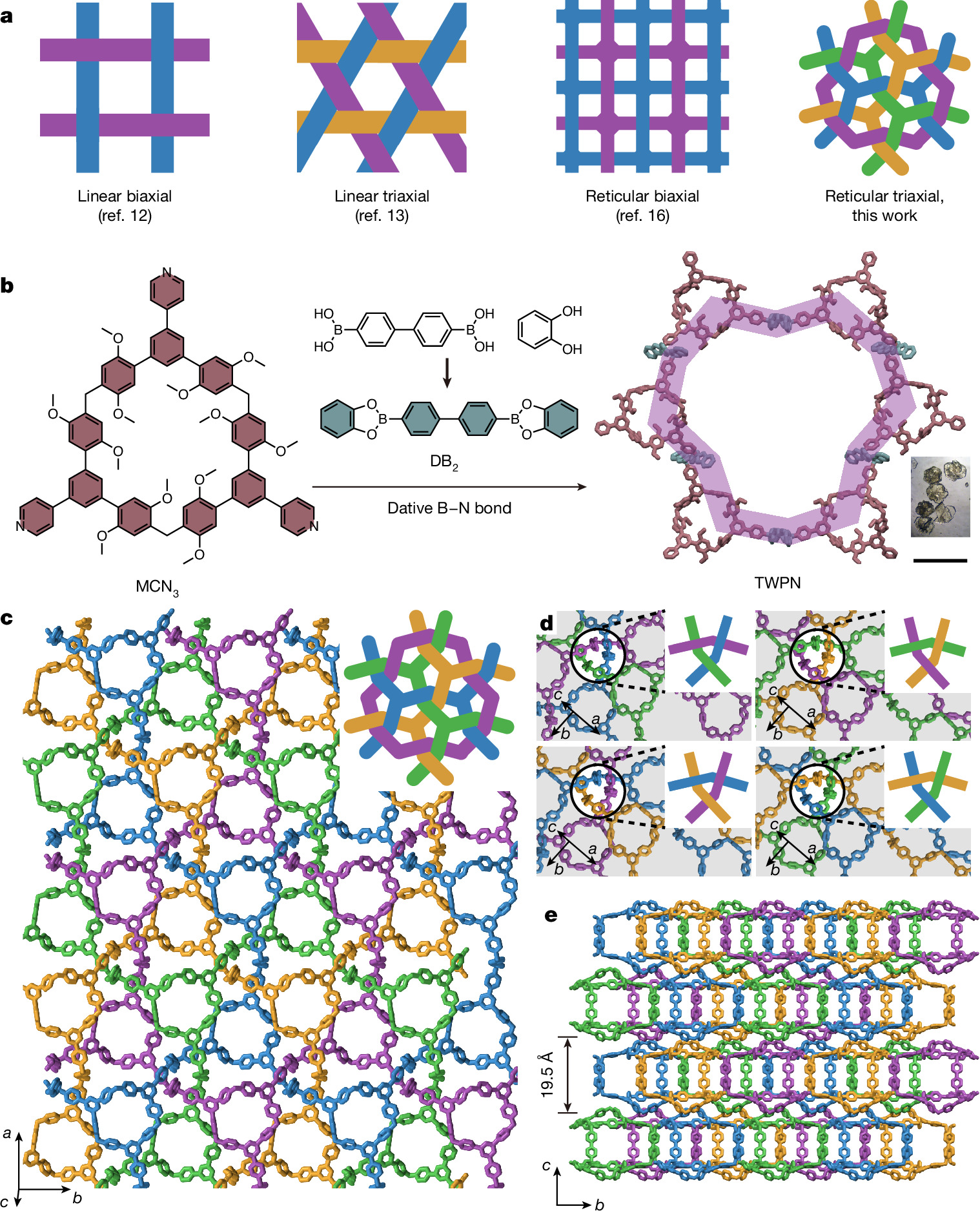
Researchers have developed a two-dimensional reticular triaxial woven polymer network. The research, published in Nature, details the creation of this material using C3-symmetric macrocycles and dative B–N polymerization.
Inspired by Macroscopic Weaving
The development is inspired by macroscopic weaving techniques. This approach, molecular weaving, interlaces molecular strands to create ordered networks, offering a strategy for designing functional materials.
Key Features of the Network
The resulting material exhibits unique topological chirality and robust mechanical properties. It also functions as a porous material capable of separating aromatic and aliphatic compounds.
Higher-Order Weaving
This research explores higher-order weaving, involving at least three axes, using nonlinear building blocks. Previous molecular weaving methods primarily utilized linear building blocks and biaxial structures. This new approach aims to create novel architectures and functionalities.
Potential Applications
The researchers suggest that this triaxial woven topology offers advantages in regulating material properties. The porous nature of the material also opens possibilities for separation applications, specifically for distinguishing between aromatic and aliphatic compounds.
Next Steps
This research represents a preview of subscription content, and access is typically provided through institutional subscriptions. Further details regarding pricing and availability may be subject to local taxes.
Source: Nature. Featured image credit: Nature.


Leave a Reply