

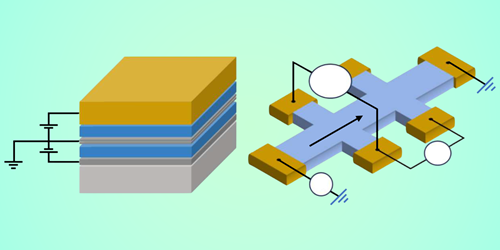
New Insights into Graphene’s Electrical Properties
Researchers at the Chinese Academy of Sciences, led by Luojun Du, have investigated the behavior of graphene in a bilayer system, uncovering distinct odd and even effects within a nonlinear Hall effect (NLHE). This research, published by the American Physical Society, could lead to advancements in electronic device design, particularly in the development of more efficient rectifiers.
Understanding Nonlinear Hall Effects
A nonlinear Hall effect occurs when an electric field applied to a material generates a transverse voltage that depends on the electric field in a non-linear way. This voltage can scale with either an odd or an even power of the electric field. Until recently, the conditions governing these two types of responses were not well understood.
Bilayer Graphene and Symmetry
The study focused on bilayer graphene, a material that possesses inversion and vertical mirror symmetries. For an NLHE to appear, one of these symmetries must be broken. The researchers found that even-order NLHEs required an additional, out-of-plane electric field to break inversion symmetry. Conversely, odd-order NLHEs needed an out-of-plane magnetic field to break vertical mirror symmetry.
Distinct Scaling Behaviors
The team observed that applying an out-of-plane magnetic field to the even-order NLHE resulted in a linear increase in the Hall voltage with increasing magnetic field strength. However, the odd-order NLHE exhibited a surprising cubic scaling in magnetic-field strength – a previously unreported effect.
Key Findings and Implications
These findings demonstrate that NLHEs can be used to probe the relationship between symmetry breaking and a material’s electronic properties. The different symmetry requirements and scaling behaviors of the odd and even NLHEs suggest potential pathways for controlling and manipulating these effects in electronic devices. The research highlights the importance of considering symmetry in materials science and electronics.
Researchers Involved
The research was conducted by Zitian Pan, Jiaheng Li, Jin Cao, Xuejin Zhang, Jundong Zhu, Yu Hong, Zhiheng Huang, Jingwei Dong, Dongxia Shi, Kenji Watanabe, Takashi Taniguchi, Wei Yang, Cong Xiao, Shengyuan A. Yang, Hongming Weng, Luojun Du, and Guangyu Zhang.
Source: American Physical Society. Featured image credit: American Physical Society.


Leave a Reply