

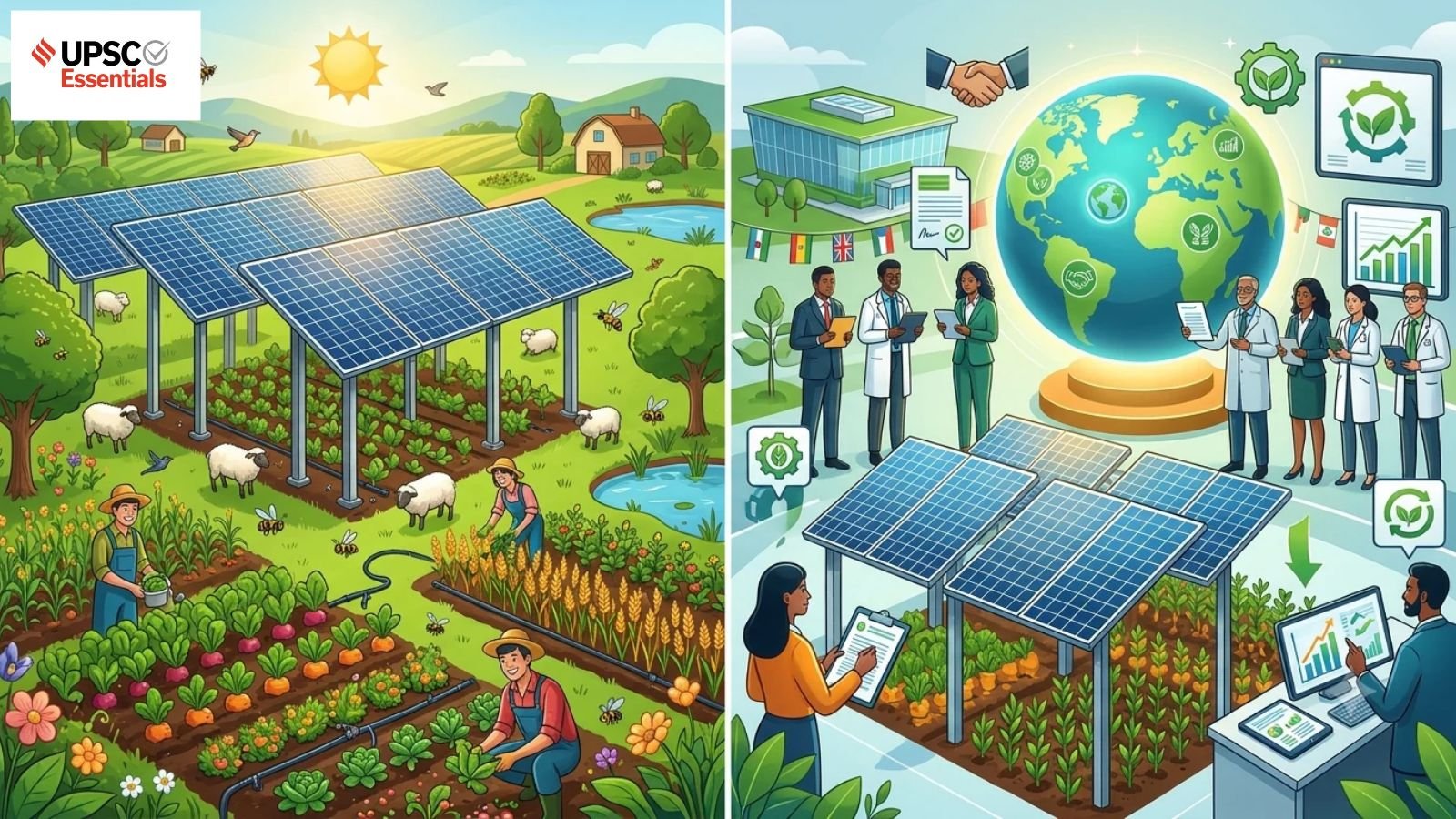
Agrivoltaics: A Dual Approach for Indian Farmers
According to The Indian Express, UPSC Essentials has released a focus question on agrivoltaics, examining its potential to enhance sustainable agriculture and bolster the resilience of Indian farmers to climate change. Simultaneously, the article explores how India can leverage emerging global environmental regulations to improve its export competitiveness. This initiative aims to provide a framework for understanding these interconnected issues.
Role of Agrivoltaics
Agrivoltaics, defined as the simultaneous use of agricultural land for crop production and solar power generation, offers a pathway to integrate food security, renewable energy expansion, and farmer income enhancement. It addresses the conflict between large-scale solar projects and agricultural activities by utilizing elevated and spaced solar panels that create a microclimate beneficial for crops.
- Solar panels can lower excessive heat and sun radiation, protecting crops from drought stress and hail.
- Electricity generation adds to crop revenue, reducing reliance on uncertain agricultural returns.
- Minimizing diesel irrigation and purchased electricity can lower production costs.
- Shade reduces soil moisture loss.
Successful implementation depends on selecting suitable crops, affordable financing, and a farmer-centric approach. The potential for job creation in solar installation and agricultural services, alongside fostering rural entrepreneurship, further strengthens the concept.
Challenges for Small and Marginal Farmers
Despite its benefits, agrivoltaics faces challenges for small and marginal farmers, primarily due to a lack of resources, technology, and experience to meet stringent environmental standards.
Global Environmental Regulations and Exports
The Indian Express highlights that global environmental policies, such as the EU’s Carbon Border Adjustment Mechanism (CBAM), are increasingly impacting international trade. However, these regulations also present opportunities for India to transition to green industrialization and diversify exports.
- India can focus on exporting green ammonia, sustainable aviation fuel, low-carbon metals, and renewable energy equipment.
- Implementing cleaner manufacturing methods and energy-efficient processes in industries like steel and aluminum is crucial.
- Affordable technologies for emissions measurement and verification are essential for demonstrating environmental performance.
Next Steps
The UPSC Essentials magazine (October 2026) provides further details and encourages discussion. Aspirants are advised to review the material and consider related questions such as: ‘What is Integrated Farming System? How is it helpful to small and marginal farmers in India?’ and ‘Describe the various Technology Missions initiated in Indian agriculture and examine their role in food security.’
Source: The Indian Express. Featured image credit: The Indian Express.


Leave a Reply