

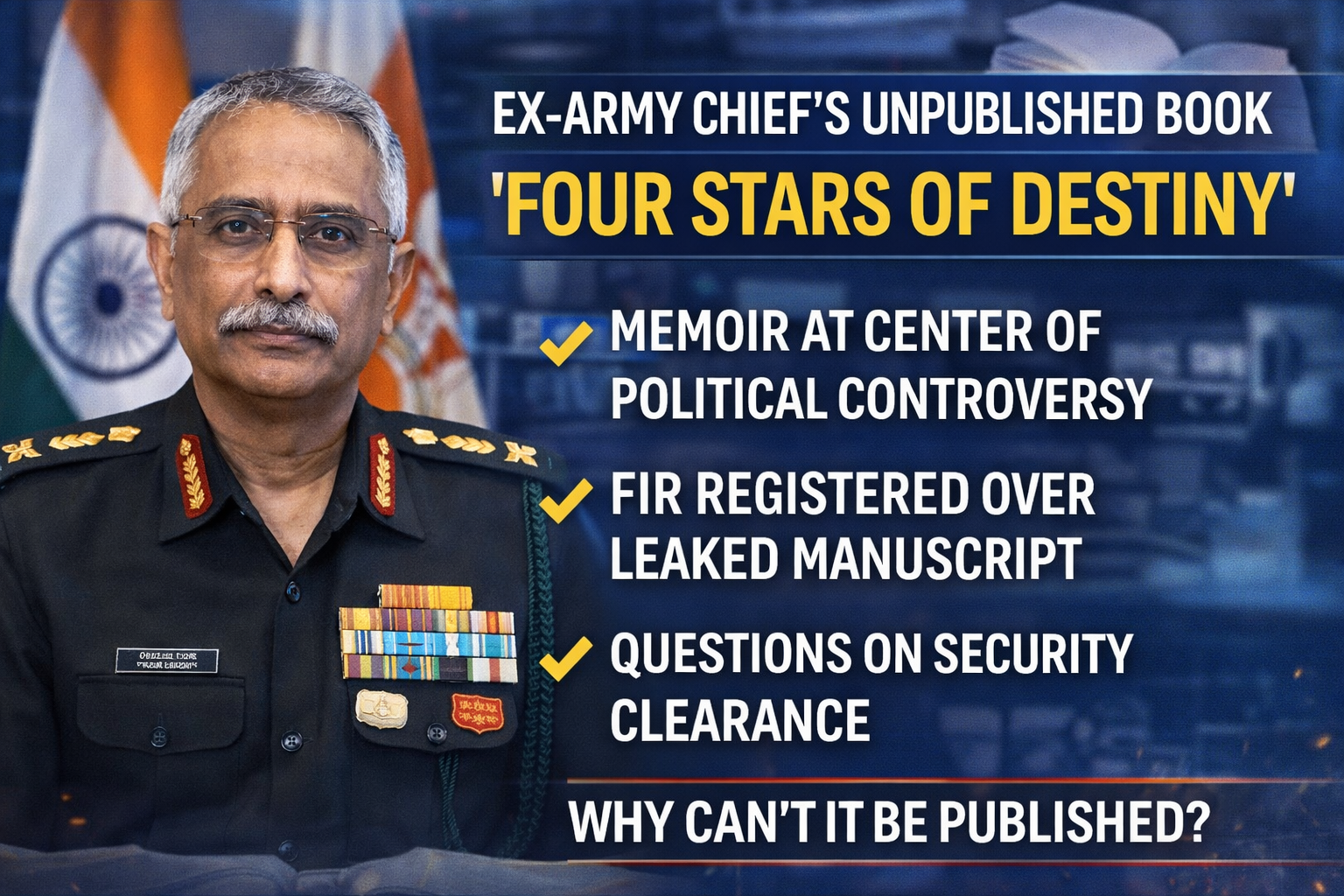
On the surface, Four Stars of Destiny is the much-anticipated memoir of a senior soldier – a book that promises an insider’s view of recent Indian military history and leadership. But over the last week it has become the centre of a political and legal storm: excerpts were cited in Parliament, the Defence Ministry and senior ministers have weighed in, an FIR was registered after alleged circulation of a pre-print PDF, and copies listed on retail sites disappeared – all before the memoir was formally cleared for publication. Below I lay out, with sources, what the book is, why it remains unpublished, how the controversy unfolded, and why the episode matters.
1) What is Four Stars of Destiny – the basics
Author: General Manoj Mukund Naravane (retired). Manoj Mukund Naravane
Form/genre: Described as a memoir/autobiography reflecting on leadership, military service and key events during his tenure. Publisher listings (publisher pages and retailer listings) show the title and publisher metadata, though availability has been in flux.
Reporting and publisher blurbs indicate the book covers operational and leadership lessons and includes Naravane’s recollections of events such as high-altitude standoffs and wider strategic issues. That framing — a retired chief’s inside perspective on sensitive events — explains why authorities and Parliament paid close attention when parts of the manuscript surfaced publicly.
2) Why the book is unpublished (and the formal rules behind that)
Books by serving and recently retired senior defence officers are subject to mandatory pre-publication clearance by the Ministry of Defence (MoD) and related authorities when they touch national security, classified operations, or internal deliberations. Multiple recent reports stress that Four Stars of Destiny had not received final clearance when excerpts began circulating. Defence Ministry and ministers repeatedly stated the manuscript had not been published.
In short: the book was pending the formal clearance process required to ensure nothing damaging to national security or operational confidentiality is released. That administrative requirement — routine for former senior officers — is the immediate legal reason why the title remained “unpublished.”
3) How the controversy erupted – timeline in facts
- Excerpts appear / are printed — Opposition leaders in Parliament quoted passages reportedly taken from the manuscript during debate, arguing the text supported their political critique of past decisions. The public quoting in Parliament is what brought the manuscript into national visibility.
- Ministers respond — Defence and home-affairs ministers and the Speaker objected to the use of an “unpublished” manuscript in debate; ministers asserted the manuscript had not been cleared or published. That triggered a parliamentary ruckus.
- Retail removal & availability questions — After the parliamentary mention, listings of the title on major online retailers either became unavailable or were pulled, prompting media queries about publication status and whether copies had leaked.
- Alleged leak & FIR — Delhi Police registered an FIR after reports that a pre-print PDF or excerpts were being circulated on social media, citing concerns about an unauthorized leak of an unpublished manuscript. Police action aims to trace the leak and identify circulation channels. (The Economic Times)
Those are the core sequence-of-events documented by major outlets; each step is reflected in official statements or police filings cited by the press. (The Economic Times)
4) Why Parliament reacted – the political stakes
When opposition MPs quoted the manuscript in Parliament, it raised two immediate issues for the government and presiding officers:
- Authenticity and provenance: Was the passage actually from the retired chief’s manuscript? Who provided the excerpt? Publishing rules and clearance status matter here. MPs using an unverified, unpublished document in parliamentary debate became a procedural and constitutional concern.
- National security sensitivity: If the text touches on operational or strategic details, public citation without proper vetting could risk revealing sensitive assessments. That is why ministers pushed back strongly. (Ministers publicly insisted the manuscript had not been published.)
Because Parliament is the arena where political narratives are contested, any document perceived to vindicate one side can instantly become a leverage point — which is why the episode produced such visible heat.
5) Was there a leak – what authorities did next
Several outlets reported social-media circulation of PDFs or printed copies; police said they were investigating. Delhi Police registered a case to trace the origin and those sharing the alleged pre-print, citing that the manuscript had not been cleared for public release. FIRs typically seek to discover whether there was an unlawful disclosure, and who is responsible for dissemination. (India Today)
At the time of writing, police action was investigatory; registration of an FIR is a fact, not a verdict. Investigations may look at internal pre-publication workflows, publisher copies, printers, or unauthorized digital sharing. Reported FIRs reflect that the state is treating alleged leakage seriously. (India Today)
6) Why major retailers suddenly showed the book as unavailable
Retail listings fluctuated after the parliamentary mention. Reports said copies were “vanished” from platforms like Amazon and Flipkart, which in practice can happen for several verified reasons: publisher request pending clearance, distributor inventory changes, or retailer compliance with legal notices while status is clarified. Several national outlets documented the sudden unavailability and linked it to the parliamentary row and clearance uncertainty. (The Economic Times)
7) What is in the manuscript (verified excerpts) – limited public record
News reports show MPs and some magazines quoted particular passages that referenced strategic events (for example, the 2020 Ladakh standoff and related decision points). But public reporting is based on fragments and quotes published by media; the full manuscript has not been publicly available in an authorized form for independent verification. That means we can report the existence of quoted passages (as cited in media/Parliament) – not the unabridged text or full context.
8) Legal and administrative background: why ex-officers face pre-publication checks
For good reason, many countries require clearance for memoirs of senior security officials. The process protects classified information, operational details, intelligence sources, and diplomatic communications. Indian defence procedures include scrutiny to ensure publication does not harm national security. Reports say Four Stars of Destiny had not cleared that process, hence the legal sensitivity and the official pushback when excerpts were used publicly.
9) Big-picture implications – why this matters beyond the headline
a. Free expression vs national security
The case raises the perennial tension: retired officials’ right to tell their story versus the state’s duty to protect sensitive information. The legal process of clearance is meant to balance these. The controversy tests where that line falls in practice and how it is enforced.
b. Political theatre and information provenance
When unpublished material is used as a political tool, questions about provenance (who leaked it, was it edited, are excerpts quoted accurately) become crucial. Parliamentary quoting of an unpublished manuscript deepens mistrust unless provenance is clear and proper vetting has occurred.
c. The rule of law and data handling
An FIR and police probe indicate the state will treat unauthorized circulation as potentially criminal; how the investigation proceeds will set precedents for how similar leaks are handled in future.
d. Public interest vs sensationalism
There is legitimate public interest in retired chiefs’ perspectives on strategic choices. But limited excerpts, circulated out of context, can create distortion and partisan uses rather than constructive national debate. Responsible publication with vetted clearance would serve public interest better.
10) What we still don’t know (and must not assume)
- The complete, final manuscript (if any final version exists) has not been publicly and lawfully released for verification. Media accounts rely on excerpts and claims.
- The identity of the initial leaker (if there was one) has not been publicly established — that is what the FIR and investigation aim to discover. Any claim about who leaked it is speculative until the probe concludes.
- Whether the passages quoted change historic or legal assessments of decisions is a matter for full context, which an unauthorised fragment cannot provide. Treat fragmentary citations cautiously.
11) Bottom line: a measured reading of events
- Four Stars of Destiny is widely reported as General Naravane’s memoir; publisher metadata lists the title, but the MoD clearance appears pending and the book has not been formally published in an authorized release.
- Parliamentary quoting of unpublished excerpts turned a limited internal document into public controversy, prompting ministerial rebuttals and a police FIR over alleged leakage and circulation.
- The episode highlights the tension between legitimate public interest in senior officials’ accounts and the need to protect national-security-sensitive information — and it shows how political use of leaked fragments can inflame debate before facts are fully verified.
Sources (selected, primary reporting)
- “MM Naravane’s book ‘Four Stars of Destiny’ cited by Rahul Gandhi disappears from Amazon, Flipkart.” Economic Times. (The Economic Times)
- “Four Stars of Destiny: The ‘unpublished’ book quoted by Rahul Gandhi that created ruckus in Lok Sabha.” Economic Times. (The Economic Times)
- “How did Rahul Gandhi get an unpublished book by Gen Naravane?” India Today. (India Today)
- “Delhi Police registers FIR over circulation of ex-Army chief MM Naravane’s unpublished book.” Economic Times / ET Online (reporting on FIR). (The Economic Times)
- Penguin Random House India / publisher listing for Four Stars of Destiny (publisher metadata). (Penguin Random House India)


Leave a Reply