

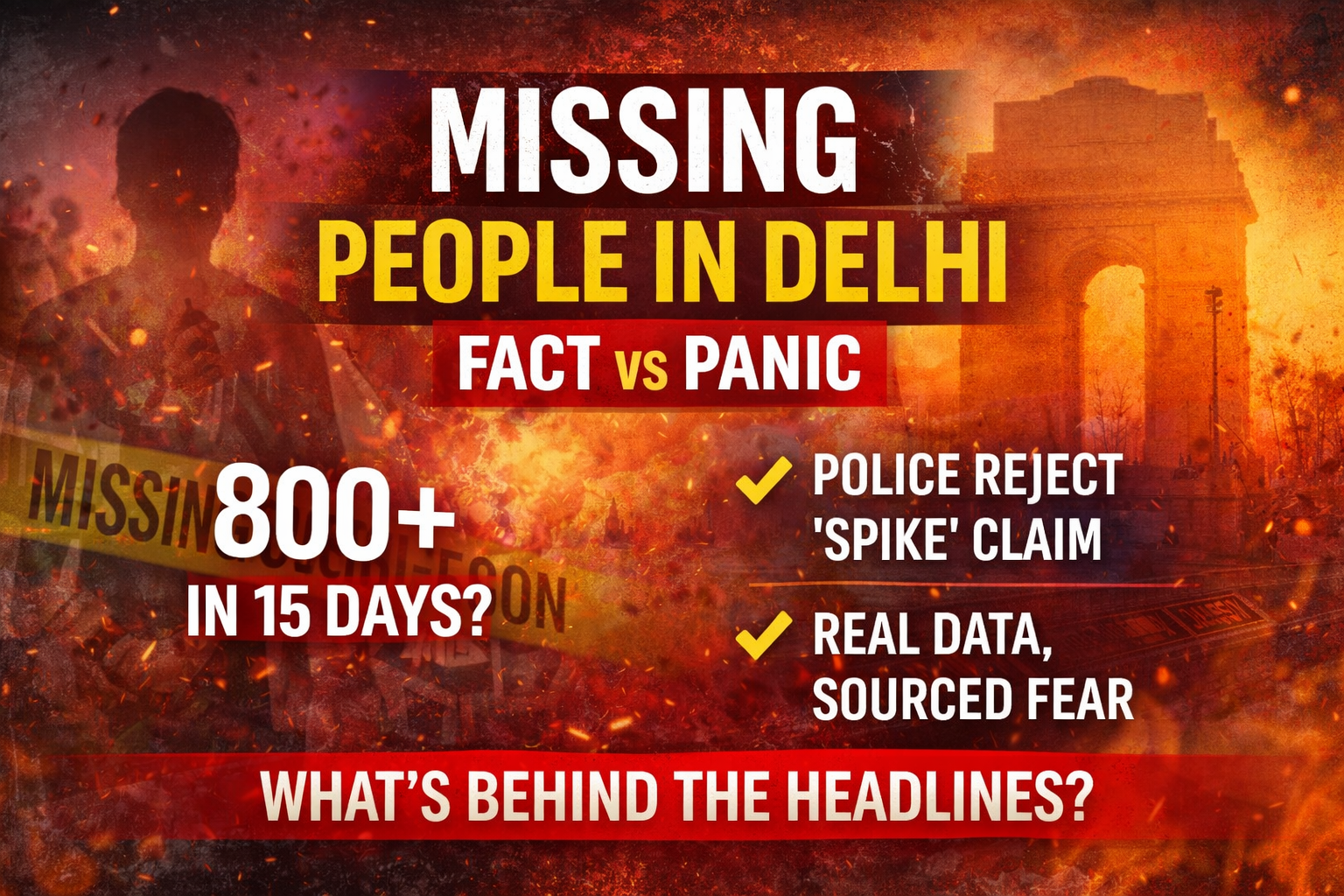
In early 2026, social media was flooded with alarming claims that over 800 people went missing in Delhi in just the first two weeks of January—including a high number of women and minors. These posts triggered widespread fear, debate, and even political responses. Important questions were raised: Is there really a crisis? Are children or women being abducted? Is something being hidden?
Let’s break it down based on official police data and verified reporting, without speculation. (The Times of India)
What the Numbers Show
According to Delhi Police data obtained by news agencies:
- 807 missing-person reports were recorded in the first 15 days of January 2026. (The Times of India)
- Of these, 509 were women and girls and 191 were minors. (The Economic Times)
- That works out to an average of about 54 missing-person reports per day for that period. (The Times of India)
These figures became the basis for viral posts claiming a “dangerous surge” in people going missing.
What Delhi Police Officially Says
Delhi Police has explicitly rejected the idea that these reports indicate a sudden spike or an ongoing crisis:
- Police say the viral panic and dramatic claims (especially focused on missing girls) are being amplified through paid promotions and misinformation online. (Hindustan Times)
- The force stated that fear-mongering for monetary gain will not be tolerated and warned that people spreading misleading content could face action. (Hindustan Times)
- In official clarifications, the police also noted that the data doesn’t show an abnormal rise — in fact, January 2026 had fewer missing-person cases than the average when compared to similar periods in previous years. (Deccan Herald)
- Authorities have emphasized that DP’s tracking and recovery mechanisms (including squads and technology) are in place, and most missing persons are traced and reunited with families over time. (Navbharat Times)
In short, there is no official determination of a “new epidemic” of disappearances, nor any confirmed systemic pattern of abductions emerging in Delhi. The police and government have publicly stated that panic is unwarranted and that normal reporting processes are being misused. (mint)
Historic Context: Delhi Has Long-Term Missing Person Reports
This isn’t a sudden phenomenon limited to 2026:
- Data collected over previous years shows that tens of thousands of missing-person cases are logged annually in Delhi, and most are resolved through investigation and tracing efforts. (The Times of India)
- Officers have stated repeatedly that missing-person reports can include voluntary departures, family disputes, mental health cases, migrants who lose contact, and other non-criminal reasons. (Navbharat Times)
- Tools like the National Crime Records Bureau (NCRB) and Delhi Police’s Integrated Police Network monitor these reports over time. These systems show that periodic fluctuations in reporting are normal.
So the number of reports in January does not by itself prove an extraordinary crisis.
Why This Became a Headline
1. High Numbers Without Context
Raw numbers like “807 missing” sound alarming on their own — but without context (trends over years, recoveries, reasons for disappearance), such figures can be misleading.
For example:
- Not all those cases involve criminal activity.
- Many are resolved quickly.
- Some involve voluntary absences, misunderstandings, or late FLRs. (Navbharat Times)
This difference — reports vs confirmed disappearances vs unsolved cases — was widely overlooked in viral posts.
2. Social Media Amplification
Delhi Police itself noted that some posts with dramatic claims were boosted as paid promotions, meaning they were deployed in a way to reach large audiences — possibly as part of marketing or influencer campaigns — rather than emerging organically from data. (Prabhat Khabar)
In particular, some narratives explicitly connected the data to entertainment promotions, which were later denied by movie makers amid controversy. (DNA India)
This mix of data, entertainment marketing, and influencer amplification meant that numbers were taken out of context and presented in a more sensational way than the raw statistics justified.
3. Public Anxiety About Safety
Even if the data itself isn’t new or unusually high, figures that involve women and children missing understandably trigger strong emotional reactions:
- Safety worries.
- Fears of crime.
- Lack of clarity on recoveries.
These are deeply human concerns, and they make for compelling headlines — even when the official data does not indicate a crisis.
Official Responses and Investigations
The headline-generating numbers have led to real institutional action:
- National Human Rights Commission has taken suo motu cognizance of the missing person reports and asked for detailed information. This shows there is serious institutional interest in understanding the data and its implications. (The Times of India)
This doesn’t mean a crisis has been confirmed, but it does mean that authorities are taking data seriously and reviewing it under human rights scrutiny.
Why Misinformation Matters
When official statistics are reframed as emergency headlines without fact checking:
Panic and fear spread rapidly.
Misunderstandings grow into myths.
Trust in institutions erodes.
Social media becomes a source of anxiety rather than information.
That is why authorities have been consistent in urging people not to share unverified content and to rely only on official updates. (Hindustan Times)
What This Means for Delhi Residents
You should know:
Official data shows reported missing-person cases — but not an extraordinary unexplained surge.
Police recovery and investigation protocols are active and ongoing.
Viral panic posts were spread and amplified, in part, through paid promotions.
Public concern is understandable, but fear without context harms social understanding.
Conclusion
The recent headlines about “800+ people missing in Delhi” are rooted in actual police reporting, but the interpretation of that data was amplified beyond context — partly through social media posts, paid promotions, and sensational framing.
According to official statements, there is no confirmed unprecedented crisis, and the numbers do not indicate a sudden threat beyond normal urban missing-person trends. What is real is the emotional reaction and the need for accurate understanding — because data without context can lead to fear, misinformation, and unnecessary panic.


Leave a Reply